 Our Offices
Early orthodontic treatment addresses bite, spacing, and jaw growth problems while your child still has a mix of baby and permanent teeth. The American Association of Orthodontists recommends a first evaluation no later than age 7, when the first permanent molars and front teeth have usually come in and bite relationships become visible.
For parents, the age 7 evaluation really comes down to one distinction. An evaluation is not the same thing as starting braces. Most children who come in at 7 are simply watched over time.
A few terms help make sense of what you’ll hear at that first visit:
- Interceptive treatment. Care that steps in early to stop a problem from getting worse, rather than fixing it after the fact.
- Phase 1. A short round of early treatment, usually between ages 7 and 10, aimed at one or two specific issues.
- Growth modification. Using your child’s active jaw growth to guide the upper and lower jaws into a better relationship.
Dr. Vance Misuraca and the American Association of Orthodontists both recommend that every child see the orthodontist by age seven, and there’s a practical reason for that number. Bone is still soft and moldable at this stage. Certain problems, like a narrow upper jaw or a crossbite, respond well now and become much harder to correct once growth slows.
At Misuraca Orthodontics, that first appointment is built around education rather than pressure, because a family who understands what’s developing in their child’s mouth can make a calmer decision about timing. Think of the age 7 visit as information gathering. You leave knowing whether anything needs attention, when it might need attention, and what to watch for at home.
What Happens at an Age 7 Orthodontic Evaluation
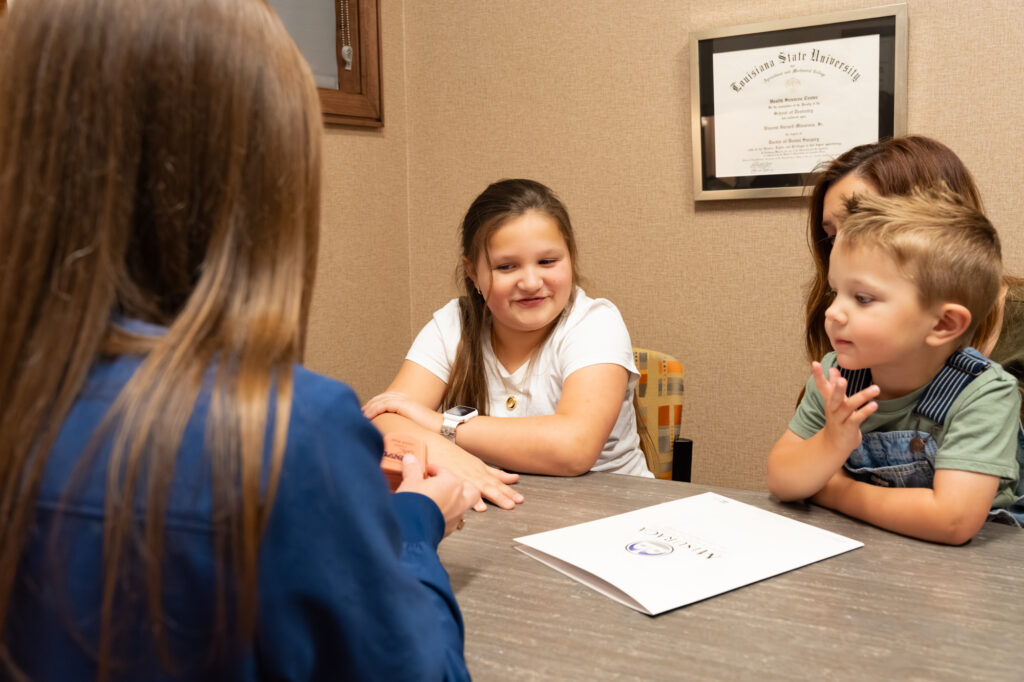
An age 7 orthodontic evaluation typically takes less than an hour and includes a parent interview, a clinical exam of the teeth, jaws, and bite, and digital records such as scans, photos, and low-dose X-rays. Dr. Vance Misuraca then explains one of three outcomes: no concerns, monitor growth, or begin early treatment.
Every early evaluation at Misuraca Orthodontics follows the same unhurried pattern, so you always know what comes next. Here’s how the visit unfolds:
- The parent interview. We ask about thumb-sucking, pacifier use, mouth breathing or snoring, chewing difficulty, speech concerns, and whether crowded teeth or jaw surgery run in your family. Family history tells us a lot.
- The clinical exam. Dr. Misuraca checks how the teeth are erupting, how the upper and lower jaws line up, how the bite closes, and whether the airway looks restricted.
- Digital records. Our digital scanners take impressions without any goopy trays, and digital photos plus low-dose digital X-rays show us the teeth that haven’t erupted yet, including any that are heading in the wrong direction.
- The diagnosis and plan. You’ll hear one of three answers: everything looks healthy, we’d like to monitor growth, or early treatment would help right now.
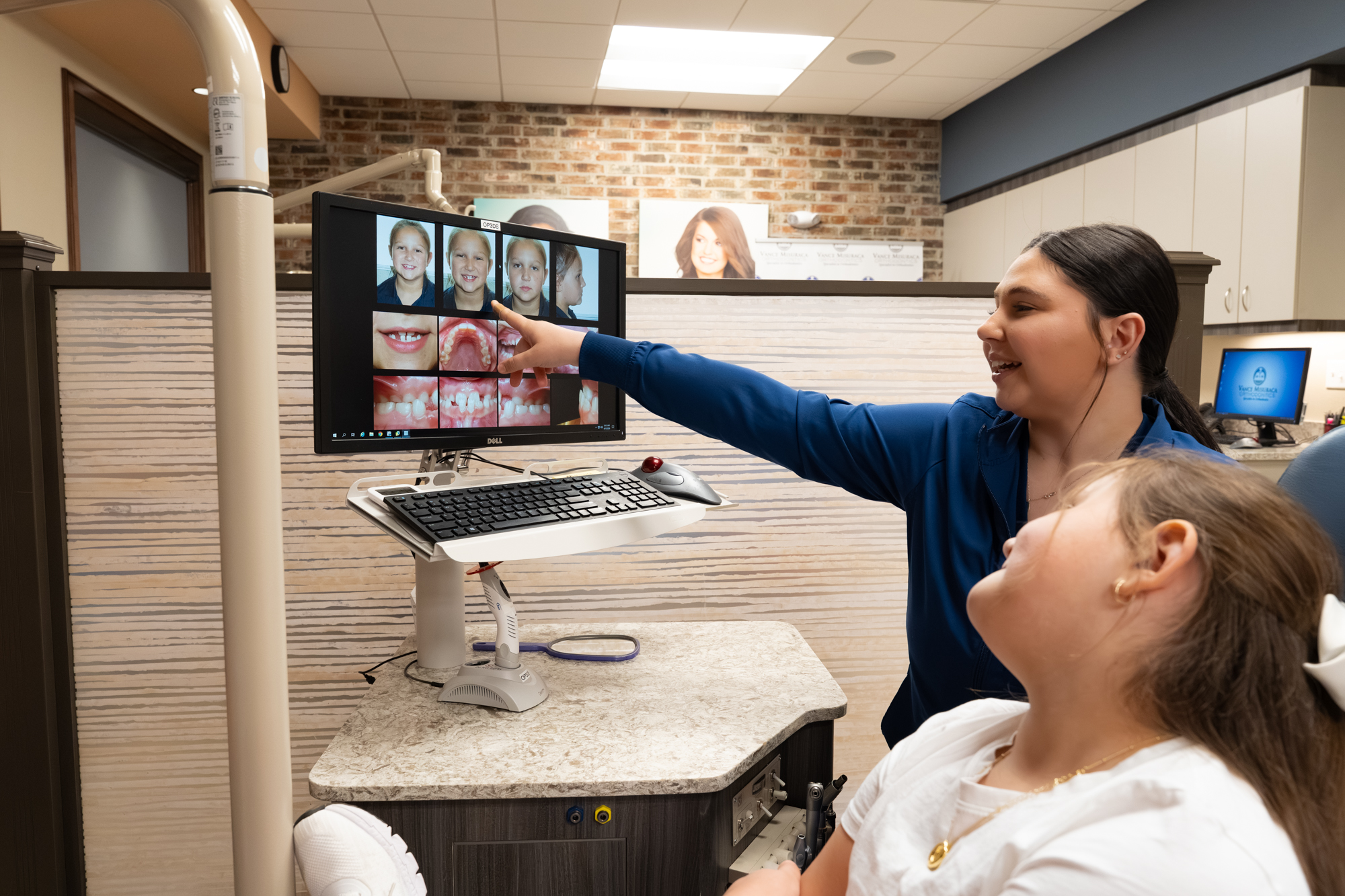
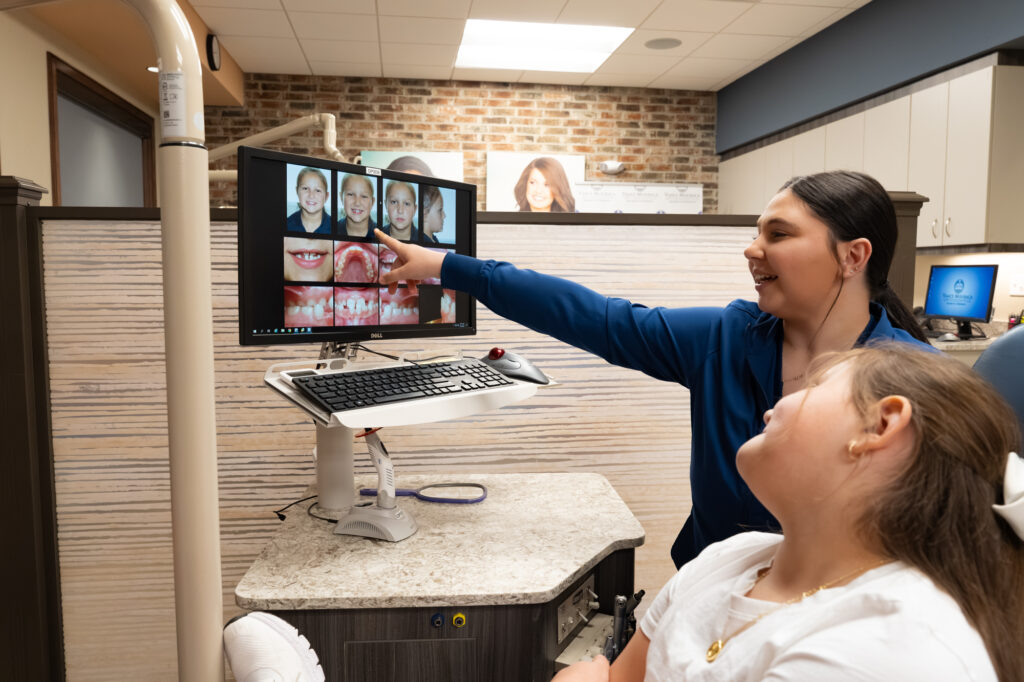
Nothing gets decided behind closed doors. We show you the images on screen, point out exactly what we’re seeing, and send you home with the findings and recommendation in writing.
If monitoring is the recommendation, your child comes back every 6 to 12 months so we can track erupting teeth and jaw development. These growth-monitoring visits are commonly complimentary, and they’re how we catch the right moment to act instead of guessing.
Should Dr. Misuraca recommend treatment and you feel ready, same-day starts mean you don’t need a second appointment to get going.
What Are the Benefits of Early Orthodontic Evaluation and Treatment?
Early orthodontic evaluation gives you options that disappear as your child gets older. Because the jaws are still growing between ages 7 and 10, we can shape development rather than work around a finished result.
The most common benefits include:
- Room for permanent teeth. Guiding jaw growth and holding space helps incoming adult teeth find their place instead of piling up.
- Fewer impacted or severely crowded teeth. Creating space early lowers the odds of a tooth getting stuck under the gums, which can require surgical exposure later.
- Correction of crossbites, underbites, and severe overbites. Bone responds best while it’s still pliable, so appliances like expanders can accomplish things braces alone can’t do later.
- Protection for protruding front teeth. Upper teeth that stick out are more vulnerable to chips and breaks during sports and playground falls.
- Habit correction. Thumb-sucking, tongue thrust, and mouth breathing can reshape the jaws over time. Addressing them early stops the damage and often improves how the bite develops.
- Simpler treatment later. Early work frequently shortens the second phase of care or reduces how much correction full braces or clear aligners need to accomplish.
There’s another benefit that doesn’t show up on an X-ray. Kids who understand what’s happening with their teeth at 7 tend to be far more comfortable and cooperative at 12.
Not every child needs early treatment, and we’ll tell you plainly when waiting is the smarter call. Recommending appliances a child doesn’t need isn’t patient-first care.
Early Treatment vs. Waiting Until All Permanent Teeth Erupt
Both approaches are legitimate. The right one depends on what’s actually happening in your child’s mouth.
| Category | Early / Phase 1 treatment | Full treatment after eruption |
|---|---|---|
| Typical age | 7 to 10 | 11 and up |
| Common appliances | Palatal expanders, partial braces, habit appliances, space maintainers | Full metal braces, clear braces, or clear aligners |
| Main goals | Guide jaw growth, create space, correct crossbites, stop harmful habits | Align every tooth and finish the bite |
| Typical length | 6 to 18 months | 12 to 30 months |
| What follows | A resting period, then a second phase in most cases | Retainers to hold the result |
Two-phase treatment simply means the work happens in two stages with a break in between. Phase 1 handles the structural issue while growth is on your side. Then comes the resting period, often a year or two, while remaining permanent teeth erupt and your child returns for periodic checks. Phase 2 brings in full braces or aligners to detail the final alignment.
Watchful waiting makes more sense when the concern is mild crowding or spacing with no bite or jaw problem underneath. In those cases, starting at 7 wouldn’t shorten anything, and treating once all the adult teeth are in is more efficient.
Certain signs suggest that delay carries real cost:
- A crossbite that’s shifting the lower jaw to one side
- A significantly narrow upper jaw
- Severely protruding front teeth
- Permanent teeth erupting on a clearly wrong path
- An underbite, where the lower teeth sit ahead of the upper teeth
Left alone, these situations can eventually require tooth extractions or, in skeletal cases, jaw surgery once growth has finished. That’s the trade-off worth discussing at the free consult.
What Are the Signs Your Child May Need Early Orthodontic Treatment?
You don’t need to diagnose anything at home. Still, a few observable signs are worth mentioning when you call.
Watch for these:
- Baby teeth lost very early or very late, or permanent teeth erupting out of their usual order
- Trouble biting or chewing, or a child who avoids certain foods because eating feels awkward
- Mouth breathing, snoring, or noisy sleep, which can point to airway concerns
- Visible crowding, unusual gaps, or front teeth that stick out well past the lower teeth
- Teeth that don’t meet properly when the back teeth close together
- A jaw that shifts, clicks, or pops, or a bite that looks off-center or asymmetrical
- Thumb-sucking or pacifier use continuing past age 4
- Speech difficulties your child’s dentist or teacher has flagged
Jot down whatever you notice, along with roughly when it started and how often it shows up. A parent’s day-to-day observations about sleep, chewing, and habits often fill in details that a single exam appointment can’t capture on its own.
Any of these deserve a look. None of them automatically mean braces.
Plenty of children we see at 7 have nothing more than normal, temporary awkwardness. Adult front teeth often erupt looking large and crooked, then settle as the jaw widens and neighboring teeth arrive. That’s development, not a problem.
For those kids, monitoring is the entire plan. We track growth every 6 to 12 months and step in only if something genuinely calls for it. Knowing your child is being watched by a board-certified orthodontist takes the guesswork off your shoulders.
Frequently Asked Questions About Age 7 Orthodontic Evaluations
Is age 7 too young for braces?
Age 7 is the right time for an evaluation, not necessarily for braces. Most 7-year-olds who see an orthodontist are monitored rather than treated. When early treatment is recommended, it usually involves a limited appliance such as an expander or partial braces on a few teeth, not a full set.
Does my child need a dentist referral for an orthodontic evaluation?
No referral is required. You can schedule a free consult with Dr. Misuraca directly. Many families come to us after their general dentist mentions crowding or a bite concern, and we’ll happily share our findings with your dentist so everyone stays on the same page.
How long does early orthodontic treatment take?
Phase 1 treatment generally runs 6 to 18 months, depending on the appliance and the problem being corrected. An expander, for example, does its active work in a matter of months and then stays in place to hold the new width. Your treatment plan will spell out the expected timeline before you begin.
Will my child still need braces later after Phase 1?
In most cases, yes. Phase 1 corrects a structural or space problem while growth is available. It doesn’t straighten every tooth, since many permanent teeth haven’t erupted yet. The later phase is typically shorter and more straightforward because the hard part is already handled.
Are X-rays safe for a 7-year-old?
Yes. We use low-dose digital X-rays, which produce a fraction of the radiation of older film systems, and we only take the images needed for diagnosis. Digital sensors generally require far less exposure than the film they replaced, and professional imaging guidance consistently favors ordering only what the diagnosis actually requires. Those images show unerupted teeth, root position, and jaw relationships that a visual exam simply can’t reveal.
What happens if we wait until age 12 instead?
For mild crowding, waiting often works out fine. For crossbites, underbites, narrow jaws, or badly protruding teeth, the window for guiding growth closes as your child matures. After that, correcting the same problem may require extractions, longer treatment, or surgery. The age 7 evaluation exists to tell you which category your child falls into. Dr. Vance Misuraca is a board-certified orthodontist and a member of the American Association of Orthodontists, and every early evaluation at Misuraca Orthodontics ends with a written summary you can keep, whether the answer is treat now, monitor growth, or nothing to worry about yet. If treatment is recommended and your family feels ready that day, same-day starts mean your child can begin without waiting for another appointment.
Looking for a Baton Rouge orthodontist to handle that first evaluation? Misuraca Orthodontics welcomes families from Central, Denham Springs, and Prairieville at three convenient offices.